
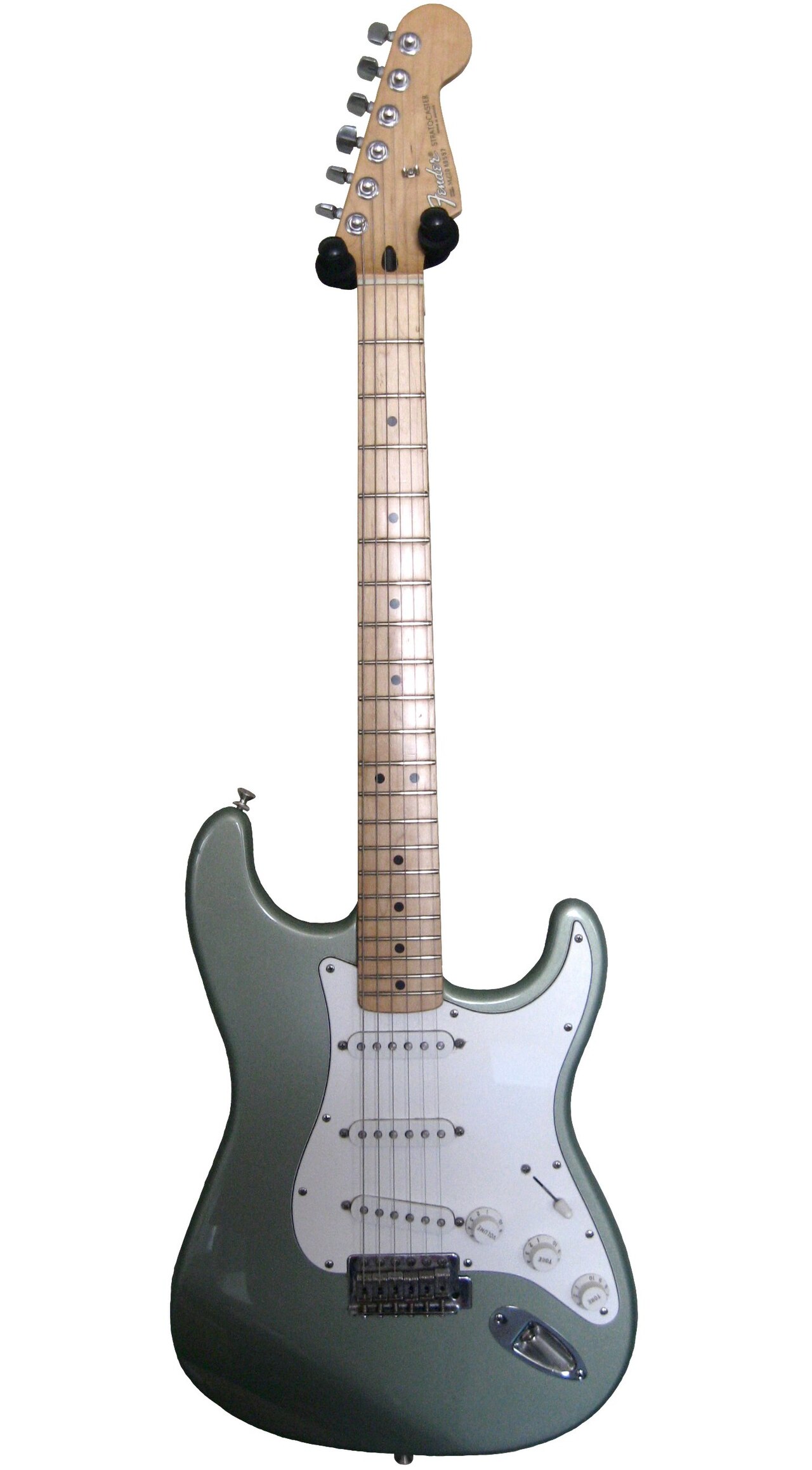
Family: String instruments
Photo: Stra2caster, Atlantictire, Public domain, Wikimedia Commons
It is hard to imagine 20th-century music without the electric guitar. Pickups – magnets wrapped in thin wire – turn the vibration of the strings into an electrical signal, and the amplifier decides how the guitar finally sounds.
A short history
In the 1930s jazz guitarists had a simple problem: nobody could hear them in a big band. The answer was the first guitars with pickups, such as the 1936 Gibson ES-150 played by Charlie Christian – the man who showed that the guitar could take solos like a saxophone. In 1950 Leo Fender launched a solid-body guitar known today as the Telecaster, the Gibson Les Paul followed in 1952 and the Stratocaster in 1954. These three models still define the shape of the electric guitar.
Fun facts
- The humbucker pickup was developed at Gibson in the 1950s to cancel the hum of single coils. As a bonus it gave the guitar a thicker, warmer tone that hard rock fell in love with.
- Distortion – the „dirty” sound – started out as a fault. Musicians noticed that an overdriven amplifier sounded more aggressive and began doing it on purpose.
In rock and jazz
In rock the electric guitar is queen: Chuck Berry, Jimi Hendrix, Jimmy Page, Eddie Van Halen and Slash defined the sound of generations. Jazz favours hollow-body guitars and a clean, round tone – listen to Wes Montgomery, Joe Pass or Pat Metheny.
Do you play this instrument? Share your experience in the comments below – tell others what is worth knowing.